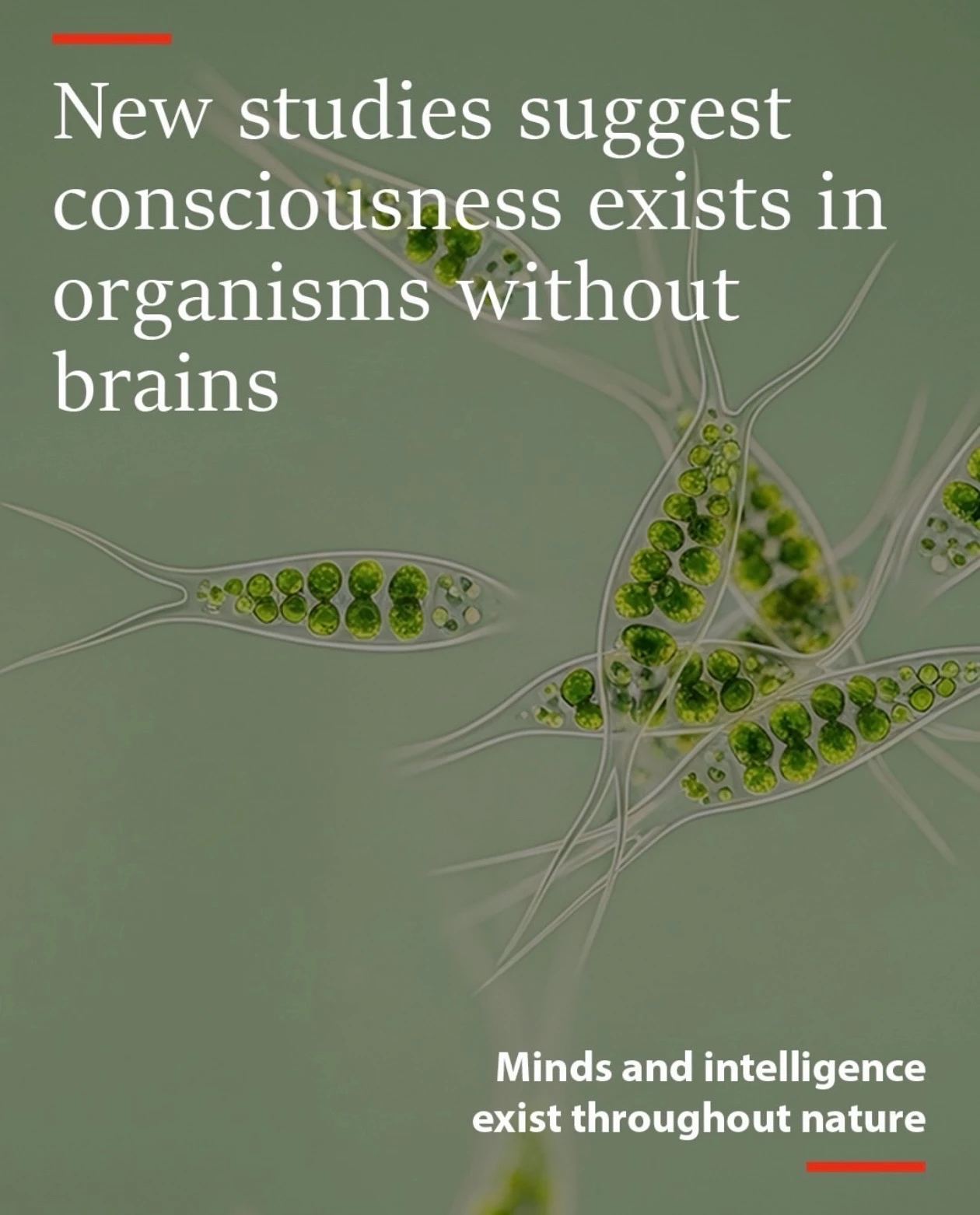
New studies suggest consciousness exists in organisms without brains
<p><em>We assume consciousness requires a human or animal brain—an assumption that author and philosopher of science <strong>Natalie Lawrence</strong> argues is the biggest obstacle to understanding what the mind actually is. Our tools for investigating cognition were built in our own image, leading us to over-attribute "life" to AI while dismissing complex organisms like slime moulds. Drawing on her research into the philosophy of biology, Lawrence explores how Spain's MINT Lab is moving beyond these biases. By designing experiments that don't use human cognition as the template, they aim to build a framework rigorous enough to finally distinguish a system that merely reacts to its past from one that genuinely experiences its present.</em></p><p> </p><p>How does a physical system such as the brain produce the ineffable phenomenon of conscious experience? Philosopher David Chalmers famously named this the “<a href="https://consc.net/papers/facing.pdf">Hard Problem of Consciousness</a>” in 1995. Proponents argue that, while cognitive functions such as categorisation or information integration might be explained mechanistically in the central nervous system, the origins of subjective experience resist such explanation. Detractors suggest that the Hard Problem is merely a collection of lesser puzzles that have yet to be solved through greater material understanding of the brain.</p><p>The heart of this controversy may lie in its core premise: that consciousness arises from a neuronal system organized around a brain. The deep entrenchment of this preconception isn’t surprising, given that our <a href="https://www.sas.upenn.edu/~cavitch/pdf-library/Nagel_Bat.pdf">own consciousness</a> is the only one we have access to. But this “brain-centrism” pervades the cognitive sciences, shaping our understanding of other beings and approaches to research. It’s one of several kinds of scientific chauvinism that currently limit the field of enquiry and hamper our scientific approach to <a href="video/the-extended-mind">other kinds of minds</a>.</p><p> </p><p><strong>The expanding view of mind</strong></p><p>Across the philosophy of mind, it is becoming increasingly clear that there are fruitful avenues for exploring the origins and nature of consciousness <a href="articles/consciousness-may-not-require-a-brain-auid-2330">well beyond neuronal systems</a>. If anything, assuming the necessity of brains is beginning to look like a fragile position.</p><p>At the radical frontiers of cognitive science, the concept of what a mind can be and the diverse systems from which it might originate are broadening. By studying organisms very different from us and our vertebrate relatives—such as plants or slime molds— researchers are revealing capacities that hint at <a href="articles/where-is-my-mind-an-interview-with-andy-clark-auid-1162">minds beyond traditional confines</a>, from <a href="https://royalsocietypublishing.org/rstb/article/374/1774/20180368/42300/Memory-inception-and-preservation-in-slime-moulds">maze solving</a> to responsivity to <a href="https://academic.oup.com/aob/article/122/5/747/4722571">anesthetics</a>. </p><p class="article-plus-content--header" style="text-align: center;">___</p><p class="article-plus-content--header" style="text-align: center;">To be properly open-minded about the possible extent of consciousness, we have to remove ourselves from the picture entirely.</p><p class="article-plus-content--header" style="text-align: center;">___</p><p>František Baluška and Arthur Reber are amongst a growing contingent of researchers who argue that to be alive might be to possess some level of <a href="https://pubmed.ncbi.nlm.nih.gov/30714631/">sentience</a>. Like intelligence, individual subjective experience probably <a href="https://www.wellbeingintlstudiesrepository.org/animsent/vol1/iss11/1/">exists across the tree of life</a>. Not as an incidental phenomenon, but because any organism—whether a bacterium or a blue whale—can only succeed at living if it has a dynamic internal experience. Each organism inhabits a unique and complex world with which it must contend to survive, for which a highly adapted mind is an enormous advantage, if not a necessity. We should expect different organisms to have <a href="https://www.noemamag.com/a-radical-new-proposal-for-how-mind-emerges-from-matter/">different kinds of minds</a>, because of the different kinds of substrates from which these minds emerge and because they have evolved in different ecologies.</p><p> </p><p><strong>Our biological assumptions</strong></p><p>Even this broader view of sentience has been critiqued for its exclusivity: the assumption that mind is confined to the kind of carbon-based life with which we are familiar. This familiarity, however, does not entail that other forms of life do not exist and could not be sentient. Or, even, that only biologically organized systems can be sentient.</p><p>Across the history of the life sciences, our assumptions have been repeatedly defied by new discoveries. Until the mid-twentieth century, for example, scientists assumed that oxygen was essential for life. <a href="https://pmc.ncbi.nlm.nih.gov/articles/PMC5921831/">Geological evidence</a> then revealed that Earth’s early atmosphere contained almost no oxygen—which suited the anaerobic microorganisms that dominated. For these single-celled inhabitants, the Great Oxidation Event around 2.4 billion years ago was a mass-extinction catastrophe. Likewise, the discoveries of <a href="https://www.nature.com/articles/35059215">extremophiles</a> in habitats such as deep-sea hydrothermal vents have repeatedly overturned longstanding ideas about the moderate conditions necessary for life to flourish.</p><p>It seems that preconceptions are difficult to escape. Just as scientific frameworks have repeatedly had to expand to incorporate new forms of life, so too will our current, rigid ideas about consciousness likely fail. We need to continually re-examine the limitations that our implicit assumptions create if we’re to have any hope of approaching these questions fruitfully. </p><p> </p><p><strong>The trap of complex systems</strong></p><p>Not without caution, however. There is a present danger in expanding the criteria for sentience too broadly beyond carbon-based organisms. It risks centering the possibility that almost any complex system, including large language models, <em>could</em> be sentient. Indeed, many people currently find it far easier to imagine that an LLM might be sentient than a beetle. This plunges us straight back into <a href="https://www.noemamag.com/what-counts-as-a-mind/">anthropocentric</a> analyses of whether our machines relate to us sufficiently to be considered conscious. Do they understand us? Do they have motivations? </p><p>As the philosopher Daniel Dennett pointed out, we very easily slip into an “<a href="https://mitpress.mit.edu/9780262040938/the-intentional-stance/">intentional stance</a>” when interacting with other agents, assuming they have beliefs and desires. The bar for mistaking these features as indicators of sentience is shockingly low, especially when <a href="https://www.apa.org/monitor/2026/01-02/trends-digital-ai-relationships-emotional-connection">interfacing</a> with systems shaped by our needs. We tend towards what we might call “AI-anthropocentrism” all too easily as a result.</p><p>We have no reason to assume that sentience will allow other systems to interact with us in a way that makes their subjective sense of awareness evident to us, however. For the same reason that minds might be as diverse as the tree of life, other forms of sentience are likely to be <a href="https://www.noemamag.com/what-counts-as-a-mind/">opaque</a> to us.</p><p> </p><p><strong>An alien life intuition pump </strong></p><p>Though it seems counterintuitive, if we can do away with biocentrism, we are freed from the need to explain why Claude or ChatGPT are not sentient. We don’t need to treat every non-biological system as a candidate mind. There could be many kinds of organisation capable of mind, most of which might have nothing to do with our technologies or the function of our own sentience. We ask instead: What kinds of organisation generate sentience?</p><p>Imagine, for example, that we live on another planet, in another solar system, orbiting a sun at “Goldilocks distance—perfect for life to flourish. The life on this planet, including ourselves, is built from <a href="https://pmc.ncbi.nlm.nih.gov/articles/PMC7345352/#:~:text=Although%20water%20is%20a%20good,is%20stable%20in%20that%20solvent.">silicon</a>, rather than carbon. To the scientists of that world, silicon would not seem like one possible basis of life among others; it would seem like the <em>obvious</em> basis of life. They might infer from their local biology that only silicon can support the organisation that living systems require and perhaps dismiss carbon-based life as mere fantasy. In that case, they would likely make the same error that we risk making: mistaking the material basis of the life that we know for the material basis of life and sentience.</p><p>
<span class="article-content-box">
<a href="video/the-mind-body-problem-and-animal-consciousness-with-peter-godfrey-smith" target="_blank" class="iai-related-in-article click_on_suggestion_link--gtm-track">
<span class="iai-card">
<span class="iai-card--image iai-related--video-play" style="display: block;">
<img src="/assets/Uploads/mind-body-problem.webp" class="iai-related--primary-image" alt="related-video-image">
</span>
<span class="iai-card--content" style="display: block;">
<span class="iai-card--title" style="display: block;">SUGGESTED VIEWING</span>
<span class="iai-card--heading" style="display: block;">The mind-body problem and animal consciousness, with Peter Godfrey-Smith</span>
<span style="display: block;">With Peter Godfrey-Smith</span>
</span>
</span>
</a>
</span>
</p><p>This “<a href="https://books.google.co.uk/books?id=9SduAwAAQBAJ&printsec=frontcover&redir_esc=y#v=onepage&q&f=false">intuition pump</a>”—another of Dennett’s terms—is not so different from our own Earth-bound position. It shows how easily such assumptions can limit the scope of our imaginations. Placing biological or structural conditions on the existence of sentience is not only tempting; it is counterproductive. What we treat as necessary conditions for sentience may simply reflect our own local evolutionary history. Brain-centrism, bio-centrism and AI anthropocentrism are forms of scientific chauvinism. They all reveal our tendency to assume the features that we experience are foundational to a phenomenon of interest, rather than ancillary or incidental qualities.</p><p> </p><p><strong>Moving to diffused cognition</strong></p><p>To be properly open-minded about the possible extent of consciousness, we have to remove ourselves from the picture entirely. We must peel back the layers of assumptions derived from our own experience to begin studying the experiences produced by other <a href="https://www.noemamag.com/ai-could-be-a-bridge-toward-diverse-intelligence/">systems</a>. Assuming that a centralized neuronal system is the gold standard for consciousness will leave us blind when it comes to the potential worlds of decentralized organisms such as slime moulds or plants. <a href="https://www.mdpi.com/2223-7747/12/9/1799">Decision-making</a> in these systems is emergent and distributed, not centrally controlled, offering fascinating possibilities when it comes to the kinds of minds they might produce.</p><p>To move forward, we need experimental strategies that do not begin with human cognition as the template for mind. There’s a growing network of researchers across science and philosophy who are doing just that. For example, the <a href="https://www.um.es/mintlab/">Minimal Intelligence Laboratory</a> (MINT Lab) in Spain is working with plant models to break new ground in the study of diffused intelligence systems. Plant experience is not directly accessible to scientific investigation, so it must be approached indirectly through behaviour and experimentally tractable proxies. Led by Professor Paco Calvo, the team is exploring how to apply experimental tools from the cognitive sciences to study plant behaviours and distributed cognition.</p><p>In the current project, <a href="https://www.um.es/mintlab/index.php/mint-lab-projects/behavioral-evidence-for-plant-consciousness/"><em>Behavioural Evidence for Plant Consciousness</em></a>, for example, Calvo and his team are developing frameworks for testing whether plants can perform advanced forms of learning. Trace conditioning, for example, involves two stimuli presented with a period of time between them. For an organism to connect the two, there must be some kind of trace of the first stimulus that persists across the time gap. Bees have been found to be <a href="https://pubmed.ncbi.nlm.nih.gov/21593307/">very capable</a> of doing this, likewise <a href="https://pubmed.ncbi.nlm.nih.gov/35173333/">fruit flies</a>. But even working out what stimulus presentations are relevant to plants and how such learning might manifest behaviourally is a new kind of challenge.</p><p>Such experimental research is the first step to unlearning the limiting assumptions that have hampered the field so far and laying the groundwork for new approaches to consciousness studies. Their aim is not to prove that plants are conscious, but rather to use the scientifically grounded study of plant behaviours as a gateway to removing our prejudices when studying all kinds of minds, including our own.</p><p>Our brain-focused neuronal system is likely just one evolutionary strategy among many. In fact, our awareness is far less centralized than we assume. Decision-making in humans, for example, is not confined to a <a href="https://www.nature.com/articles/nrn.2017.7">single brain </a><a href="https://www.nature.com/articles/nrn.2017.7">region</a>, but distributed across interacting regions and systems. Plants, microbes, and other life forms show that cognition can emerge in <a href="articles/biology-not-physics-holds-the-key-to-reality-auid-3163">radically different organizational forms</a>, and it’s possible that sentience does also. If we can relinquish our assumptions of centralized, neuronal consciousness that must resonate with our own, we might find ways to understand other kinds of mind. This will be the only way we might eventually understand what consciousness is and how it emerges.</p>
iai.tv



Comments (0)
Sign in to join the conversation
No comments yet. Be the first to share your thoughts!