An interesting reminder that feeling accustomed to less sleep does not necessarily mean our bodies are functioning optimally.
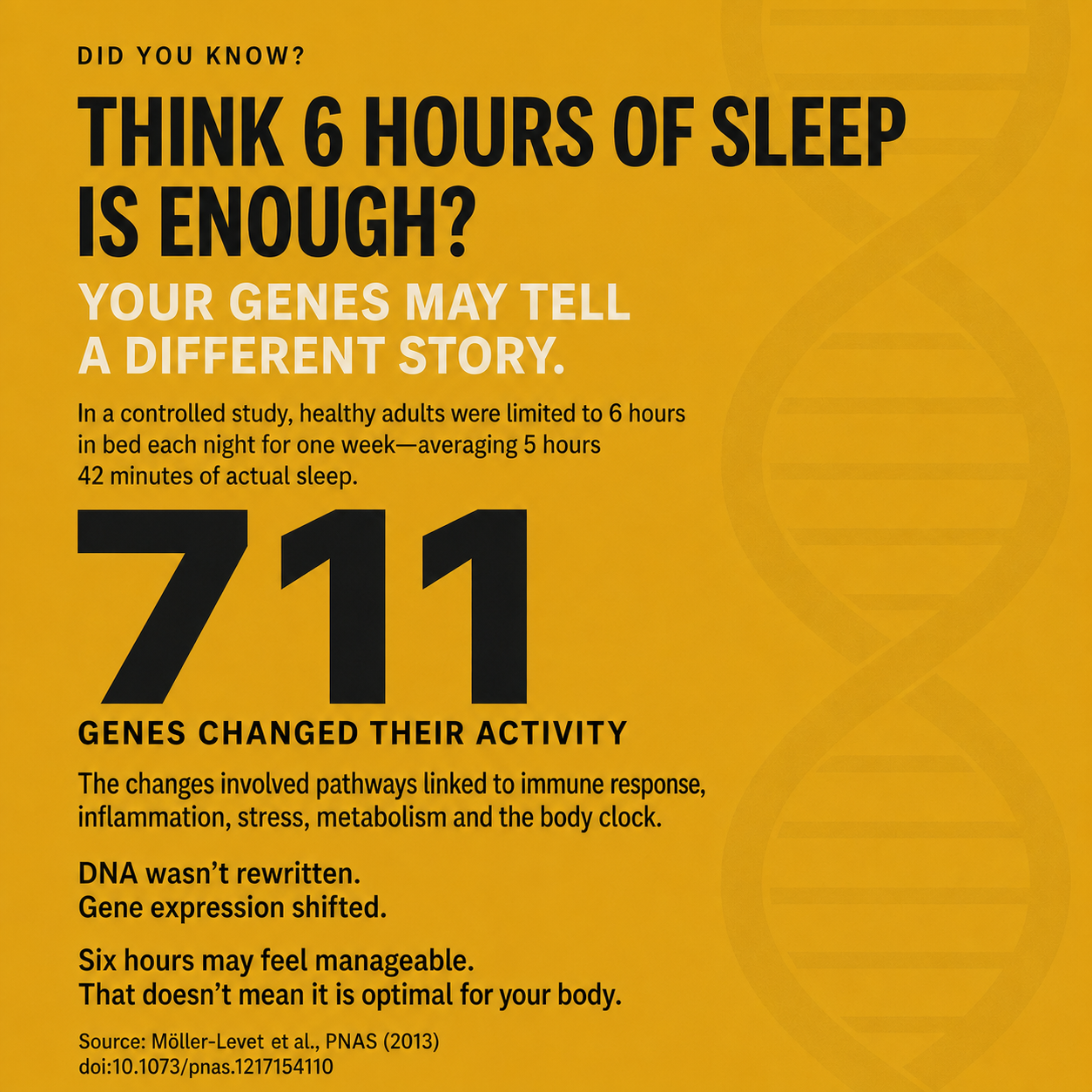
Many of us assume 6 hours is enough because we can still get through the day. But functioning & fully recovering are not necessarily the same thing.
In a controlled study involving 26 healthy adults, 1 week of being limited to 6 hours in bed each night—averaging 5 hours and 42 minutes of actual sleep— was associated with changes in the activity of 711 genes. The affected pathways included immune response, inflammation, stress, metabolism and the body clock.
To be clear, the participants’ DNA was not damaged or rewritten. The study detected short-term changes in gene expression—how actively certain genes were switched up or down.
How many hours of sleep do you usually get—and do you genuinely feel restored the next day?
Source: Möller-Levet et al., PNAS (2013)
In a controlled study involving 26 healthy adults, 1 week of being limited to 6 hours in bed each night—averaging 5 hours and 42 minutes of actual sleep— was associated with changes in the activity of 711 genes. The affected pathways included immune response, inflammation, stress, metabolism and the body clock.
To be clear, the participants’ DNA was not damaged or rewritten. The study detected short-term changes in gene expression—how actively certain genes were switched up or down.
How many hours of sleep do you usually get—and do you genuinely feel restored the next day?
Source: Möller-Levet et al., PNAS (2013)

by Kiran Sandhu
• 2 hours, 14 minutes ago



Comments (0)
Sign in to join the conversation
No comments yet. Be the first to share your thoughts!